
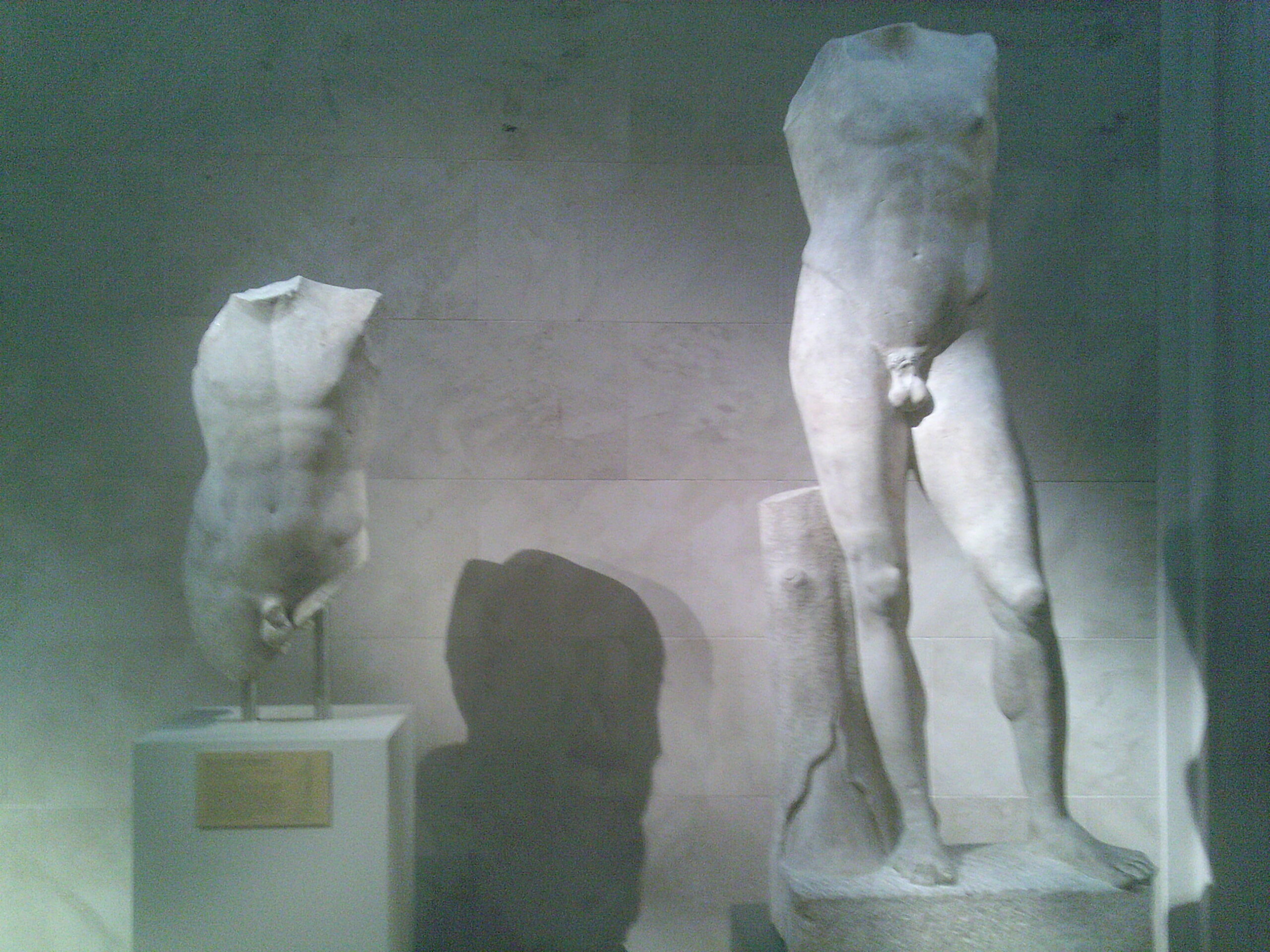
The Divine Male Body: Queer Desire in Imperial Roman Art
Antinous, the young companion and lover of the Roman Emperor Hadrian, is a tale of beauty, youth, desire, and death. Antinous was a young boy when he met Hadrian in the Roman province of Bithynium, in Claudiopolis. Antinous became an object of Hadrian’s desire, and upon his death, which, while contested, is theorized to be a drowning sacrifice to extend Hadrian’s life (Kogan Penha 2024, 72), Hadrian had thousands of statues, coins, jewelry, and other objects made in his image. Antinous became deified and frozen as an eternally beautiful object of Hadrian’s desire, and has gone on to be an image of queerness throughout history, becoming the “gay god” for people in the 19th and 20th centuries. While within the developing empire, identity and sexuality were heavily centered on status, homoeroticism, and queer desire can still be found within the art of the time. Before getting into my argument, I want to acknowledge that using words and language like “queer” and “homoerotic” are modern terms; there are no exact ancient terms that we can use, and no direct primary sources that I have found that discuss such topics. These terms provide the language to discuss and read the art and the context surrounding it. Across Roman imperial art, representations of beautiful young male bodies repeatedly appeared in mythological scenes, luxury objects, and divine portraiture that connected masculinity, beauty, and homoerotic desire. Images of Greek myths like Ganymede and Zeus, or Apollo and Hyacinthus, to depictions of male-on-male intercourse on cups, and of course, images of deified lovers of Roman Emperors. These objects, in their visual language and cultural context, suggest homoerotic fantasy and queer desire, using idealized male bodies. In this paper, I will argue that Roman mythological and imperial imagery transformed idealized male beauty into a socially meaningful, immortalized form of queer memory, desire, and power.
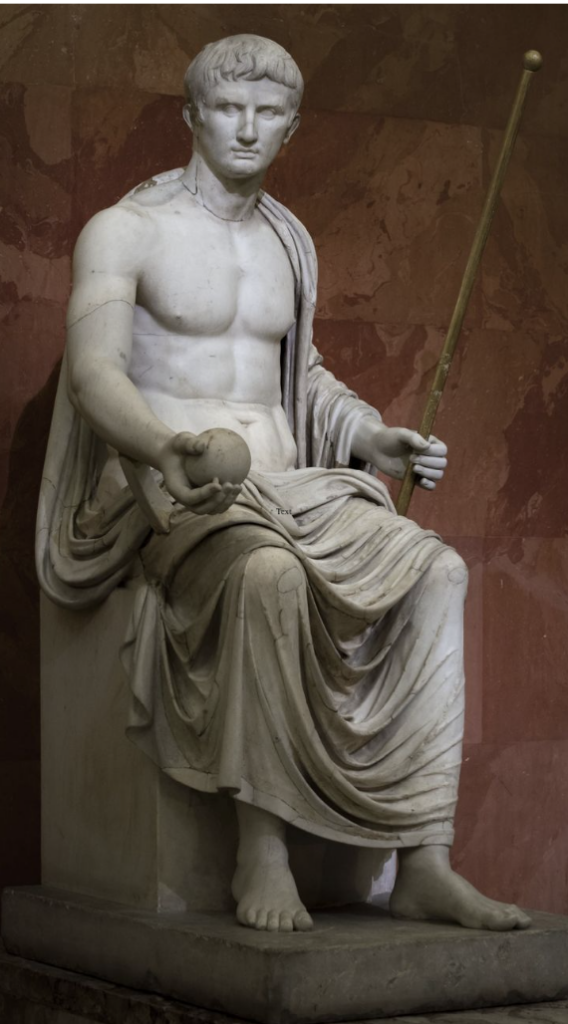
The statue of Augustus, seated on a throne, holding an orb and a golden scepter, was originally owned by Marquis Compana, a prolific collector of antiquities from Italy and the ancient Mediterranean world. The specific piece was brought to the museum in 1862 in a collaboration between the Hermitage and the Louvre, after previously being displayed in Rome by the Campana collection.
The statue of Augustus depicts him in the image of the God Jupiter, the presiding god of the Roman Empire. Augustus previously depicted himself in association with Jupiter in pieces like the Gemma Augustea. This specific piece serves as a reference to the imperial art style started by Augustus, its connection to divinity, and idealized male form, not inherently queer in its selection.
The Male Body: Augustus and Apollo
Gaius Octavian was adopted by Julius Caesar in 44 BCE and became the first emperor of the Roman Empire. He ushered Rome out of the Republican era into a grander vision of the growing empire. To represent this new Empire, he created a new visual language, Augustan portraiture. Portraiture in the Roman Republic was heavily veristic, showing age and wisdom through emphasis on wrinkles and facial lines, balding, and severe expressions. The new style expressed how he imagined himself and Rome as Augustus (the “revered”), constructing that identity. The new type is marked by a harmony of proportions, inspired by the work of Polyclitus, becoming a completely intellectual and artificial work of art, composed of Classical forms subtly mixed with just a few authentic physiognomic traits, in the end turning Augustus into an ageless classical beauty (Zanker 1988, 98-99). Octavian Augustus as Jupiter is a statue created towards the end of his reign or shortly after his death, depicting him as the god Jupiter. The statue features his classic face sculpt, eternally showing him as youthful despite him reigning into his 80s. The aesetisized heroic nudity of the statue is the first indication of divinity, showing Augustus with idealized male form and proportions, paired with bare feet, another way of depicting gods in classical art. This sculpture points to a visual language of idealized male bodies and divine imagery being used in imperial art, and while not queer provides a blueprint to construct queerness out of.
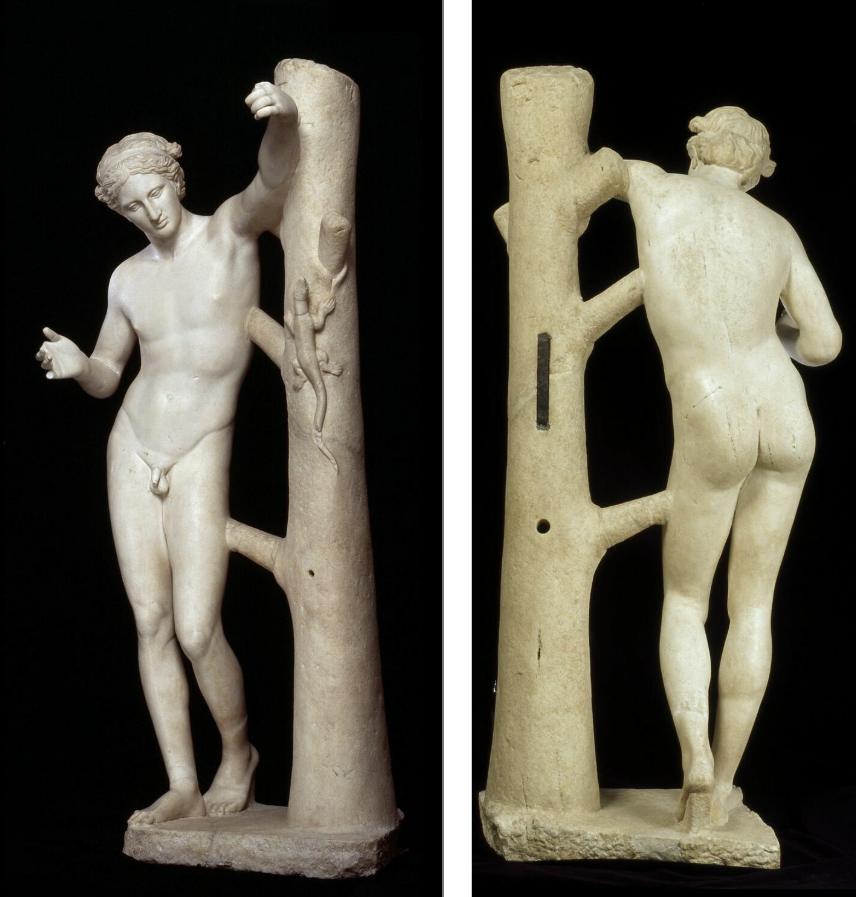
The Apollo Sauroktonos (Apollo the Lizard Slayer) was discovered in Italy before the year 1650 and was previously owned by private collector Camille Borghese. The piece was acquired by the French state and given to the Louvre in 1807. According to the Louvre, the right forearm and hand, the left arm, forearm, and hand, the right ankle, the genitals, and the lizard’s head were missing and restored in antiquity before acquisition. The head, the ankles, points of attachment between the tree and the statue, and the tree (which was in two pieces) were reattached.
The piece serves the purpose of not only providing a more historical example, being before imperial and even republican times, but also showcasing examples of the divine male form and a connection between Roman art depictions and Greek art.
To help his construction of idealized youthful beauty, Augustus aligned his image with that of Apollo (Zanker 1988, 100). In Greek and Roman mythology, Apollo is the sun god and the god of music and art. He is often depicted as the pinnacle of idealized male beauty, youthful and playful, with a perfect body. Apollo Sauroktonos is a marble copy of a bronze original in Greece, created in the Late 4th century. In the piece, we see Apollo in the classical, idealized youthful image. His body is perfectly proportioned and smooth, with detailed musculature on his chest, abs, and arms. His long hair is falling around his face while gently pulled back into a bun. He is the perfect ideal male beauty. In a chapter from his book Articulate Flesh: Male Homo-Eroticism and Modern Poetry titled “The Male Body,” Gregory Woods argues that in ancient Western art, there are three archetypes of the Male body. Narcissus, Apollo, and Heracles. The first Narcissus is the youthful, soft, adolescent beauty, associated with pliancy, promise, and receptive sexuality, admired more for beauty and erotic potential than physical dominance. The second Apollo is balanced, mature beauty, graceful, proportioned, adaptable, and combines masculine strength with aesthetic harmony, presented, as I’ve stated, as the “ideal ideal” because he unites multiple erotic possibilities in one body. And finally, Heracles muscular, hyper-masculine potency, strongly phallic and physically dominant, associated with force, power, and sexual aggression, is positioned “on the verge of deterioration,” suggesting excessive masculinity eventually decays (Woods 1987, 9). Narcissus and Heracles are opposing sexual forces, with one’s ass being designed to be dominated by the other’s phallus. Apollo falls in the middle, a harmony of sexual submission and domination. We see this in his sculpture with both a defined phallus and ass, “for we must be able to wander at will from penis to buttocks to penis, gazing at his statue… making love with each aspect of him in turn” (Woods 1987, 9). Apollo becomes an image of homoeroticism in art, representing both the dominant and the submissive, a dynamic present in myths of his own (Apollo and Hyacinthus) and in historical relationships (Hadrian and Antinous). Augustus’ use of an image with queer erotic readings in constructing his imperial image and subsequent imperial portraiture to come, while not intentionally queer, connects queer sexuality into readings of art of the imperial era. Both sculptures (Augustus as Jupiter and Apollo Saurktonos) point to a visual language of idealized male bodies and divine imagery being used in imperial art, providing a blueprint to construct queerness out of.
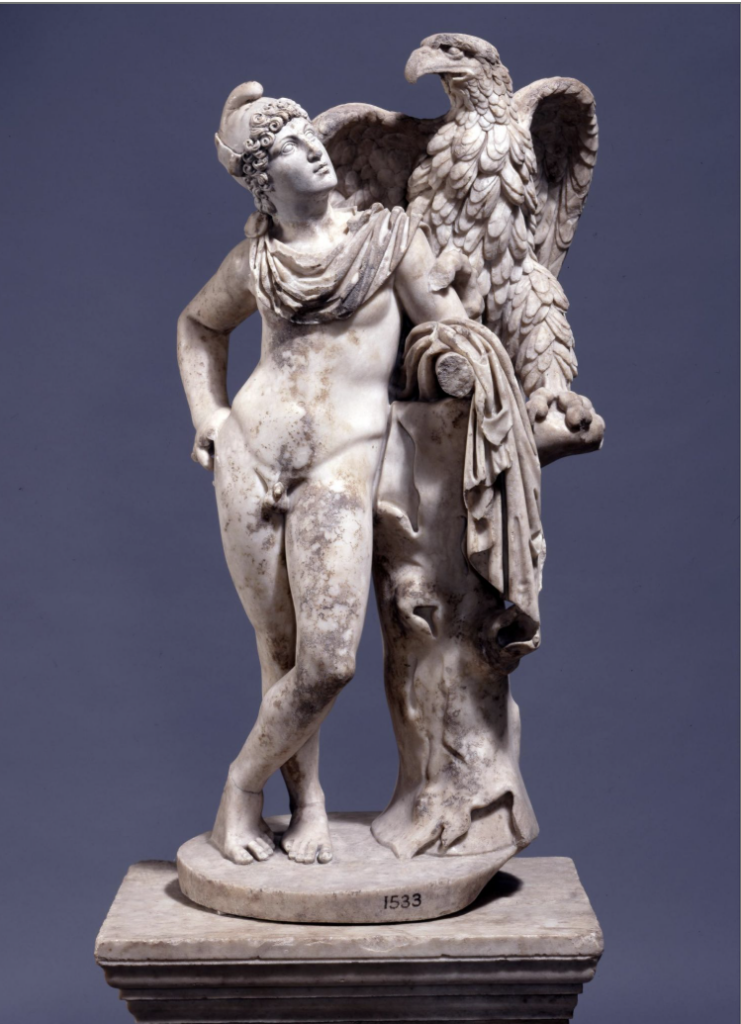
The sculpture depicts the myth of Ganymedes and his abduction by the enamored Zeus as a child. The piece was found in antiquity in Italy. It was acquired by the British Museum in 1888 from a private collector by the name of Torquato Castellani, who was a 19th-century italian Glass smith and potter. The details of the museum’s acquisition and any other notes on provenance are not available.
The piece depicts the myth of Ganymedes, who was kidnapped by Zeus as a child after Zeus fell in love with him. Upon his arrival on Mount Olympus, Zeus made him eternally young and beautiful. This piece shows mythological representations of queerness in art.
Queer Mythology: Eagles and Griffins
In The Iliad, Homer tells the myth of Ganymedes, the prince of Troy. In the myth, Ganymedes is seen by Zeus, king of the gods, as the most beautiful mortal, the perfect youth. As he is tending to a sheep in a field is swept up by an eagle and carried to Olympus, where Zeus makes him immortal and eternally youthful, and gives him the duty of being Zeus ‘ cupbearer. In its original telling, the Myth was not a story of homoerotic attraction; however, later on, that connection was made. Thomas K. Hubbard notes that Augustan poetry adapts Greek pederastic traditions into Roman literary culture, where myths of male homoerotic desire become recurring literary themes (Hubbard 2003, 345–346). In the statue of Ganymedes and the Eagle, we see Ganymedes looking up at an eagle perched above him, the eagle representing the god Zeus. While not in human form, the Eagle/Zeus is a dominant figure in the statue, with Ganymede looking up at his face. His wings he is positioned halfway behind Ganymede with wings extended just enough to engulf his back. The positioning can be compared to that of a taller, stronger man standing behind Ganymede with an arm protectively around his back and shoulders. Using the tools provided by Woods, we can read this Eagle/Zeus as a Heracles figure. The Woods tools can also be seen in the rendering of Ganymedes, demicting him with smaller, boyish proportions, while he does have musculature and an idealistic frame, it is far less defined than that of Apollo or Augustus, and finally, his phallus is small and far less visible on his body. In the chapter “The Male Body,” Woods addresses Ganymede, referring to him as a measure of youthful male beauty. He also refers to the myth, saying that any reference to Ganymede implies sexual acts and desire, and the use of the abduction by Zeus implies sexual intercourse (Woods 1987, 24-25). In Hubbard, we can see that this reading of the myth was also prevalent. In Ovid’s Metamorphoses, Jupiter becomes “on fire / For Phrygian Ganymede” (Hubbard 2003, 380) before abducting the Trojan youth to Olympus, explicitly framing the myth through male desire.
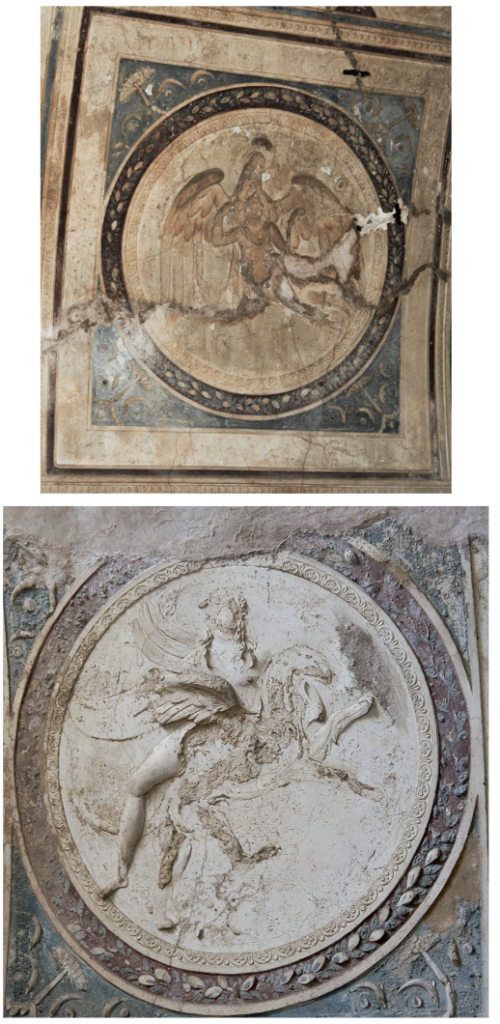
The two plaster stucco ceiling reliefs are located in the Forum Baths of Pompeii in the Tepidarium, a hot room, on opposing arches of the ceiling. The ceiling of the baths was restored with Plaster Stucco following the earthquake in 62 CE. The bath complex was excavated between 1823 and 1824.
The first relief depicts Ganymedes being hoisted into the air by an eagle, a representation of Zeus. The second depicts the myth of Hyacinthus, a Spartan prince and Apollos young lover, who was killed by a discus blown off course by the jealous god of wind Zephyrus. Following his death, Apollo creates the Hyacinth flower. The two are seen seated on a griffin together. The two reliefs show a secondary tale of mythology and queerness, as well as depict it in a less elite setting. They also tie in ideas of idealized beauty, queer longing, and desire
Ganymede is not the only prince to be favored and loved by a god. The Spartan prince Hyacinthus was the young lover of Apollo. The two are commonly depicted as companions and lovers in ancient literary and artistic traditions. According to the myth, Apollo taught Hyacinthus music, athletics, and hunting, and the pair spent much of their time together. In the end, Hyacinthius is killed by a discus blown off course by a jealous Zephyrus, a wind god, and Apollo creates the hyacinth flower from his blood. In the Tepidarium, in the Forum Baths in Pompeii, are two stucco plaster reliefs. One depicts Ganymede being hoisted into the air by an eagle. The second is less preserved but features a figure seated upon a flying griffin. According to Hakanen, the relief is of Hyacinthus and Apollo. The griffin, being a common symbol of Apollo, points to the youth being one of his lovers, Hyacinthus. Once again, returning to the Woods tools, we can compare the two reliefs, as they seem to be companions, being placed in the same place on opposing walls. In the relief of Ganymede, he is pictured being lifted by his arms by an eagle, looking up towards the eagle’s head, like in the sculpture, reinforcing the Narcissus and Heracles dynamic. While Ganymede is being carried below the eagle, Hyacinthus is riding the griffin; this isn’t an indication of Hyacinthus being dominant, as Apollo is a harmony of domination and submission, his riding on his lover’s back more so points to an equality of their relationship, as is present in their myth. Hakanen expands on the significance of these queer and homoerotic myths being present in the bathhouse as introducing and combining “ideals of strength, endurance, and self-control with images evoking pleasure, luxury, and erotic desire.” (Hakanen 2020, 55) The bathhouse was a place of forming masculine identity socially and evaluating status. “The erotic imagery of Ganymede and Apollo-Hyacinthus introduced themes of desire, beauty, and submission into a space otherwise emphasizing normative masculine virtues.” (Hakanen 2020, 61) These reliefs not only show the role of these queer stories in Roman life, not just in elite settings, but also tell us these myths were culturally understood for their queerness and normalized in masculine social spaces.
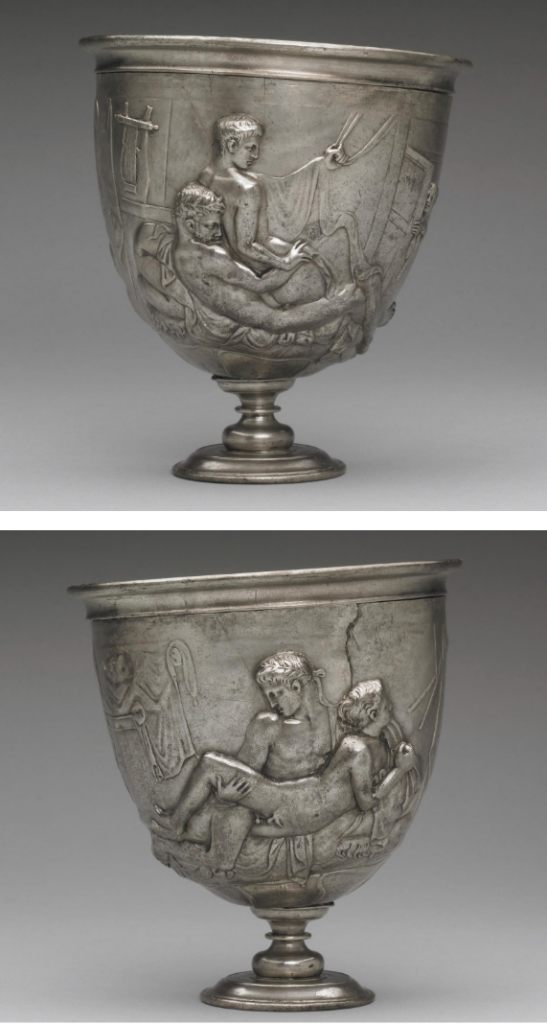
The Warren Cup was most likely made in the Middle East, in the Levant region, province of Rome, though at the time of production, between 15 BCE and 15 CE, the area was controlled partially by the Parthian Empire. The cup was acquired by the British Museum in 1999 from an anonymous collector, although it was previously owned by Edward Perry Warren, a US archaeologist and private collector. The cup originally had two vertical handles on either side, but those were lost.
The piece shows another example of queerness in the further reaches of the Roman Empire, though this time not in the guise of mythology, but between two couples: an older man and boy on one side and two boys of similar age. The cup also connects in imperial portraiture with the boys being depicted with many similarities to Emperor Augustus.
Homoeroticism: The Warren Cup
Mythology presented a way of coding Imperial art with queer desire and homoeroticism. Allowing queerness to be interpreted from the pieces while serving the larger social and cultural purposes. There are objects that remove any idea of coding and explicitly express homoerotic sex. The Warren Cup is a silver drinking cup that comes from the easternmost part of the empire, in the Levant. The cup was cast out of silver and then engraved. The cup is split into two distinct scenes. Scene A depicts a younger male seated on an older bearded man’s phallus; the couple is shrouded in sheets from behind, leaving their sexual act visible to the viewer but concealed to someone on the other side. In the right corner of the scene is a younger boy watching from behind a door, and on the left is a lyre. Using the Woods reading, we can see a Narcissus and Heracles, or Zeus and Ganymedes, dynamic between the two. While the piece was discovered in the eastern empire, it is clearly conforming to Roman portraiture of the time; the young boy seated atop his lover is etched in classic Augustan style. His face shape echoes that of Augustus, but the style is clearer in the comma-shaped curls encircling his head. John R. Clake, in his article on the object, agreed with this statement, saying the piece was an example of the success of Augustus’ visual propaganda (Clarke 1993, 281). The Augustan portrait style can also be seen on scene B of the piece. On this side are two boys of around the same age, also engaged in penetrative sex. While the previous couple was seated one on top of the other, this couple lay horizontal to each other, with the more dominant figure seated upright holding his lover’s leg. The style of laying evokes images of Greek symposia and Etruscan dining art. This younger couple both feature Augustan comma curls, with youthful, idealized bodies. Though the muscle definition we see on marble sculpture is less visible on silver, there is still definition in the shoulders and pectorals. This couple visually aligns with Wood’s understanding of the Apollo type. Neither scene is entirely free of any divine imagery; both dominant males wear coronae, possibly symbolizing them as gods, though which gods is not explicitly clear. Clarke makes the claim that throughout the empire, homoerotic imagery was common on dishes in both poor and elite spheres and that there were workshops dedicated solely to the production of homoerotic pieces (Clarke 2001, 278-279). The Warren Cup demonstrates that the visual language Augustus used to construct imperial beauty and authority extended beyond official portraiture into explicitly homoerotic art. Idealized youthful male bodies, originally developed to communicate imperial divinity and perfection, became equally capable of aestheticizing queer desire and male-male intimacy throughout Roman visual culture. Further, the cup emphasizes that homoerotic imagery was not an isolated or hidden artistic tradition.
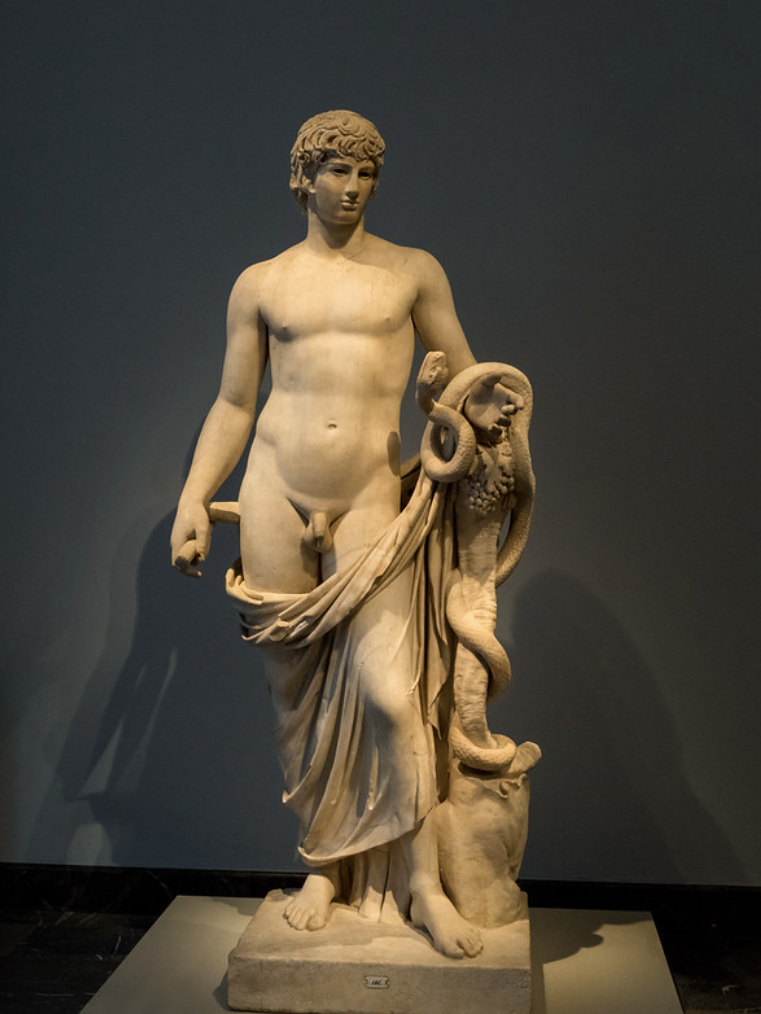
The Statue of Antinous was discovered in Italy and is currently on display at the Berlin State Museum. The museum does not provide much information on the piece’s provenance besides stating it was purchased in Rome, though there is no provided date of purchase or previous owner.
The piece is a depiction of Antinous in the nude, which is a slightly less common form for the depictions of Antinous. In the statue, Antinous is depicted in the form of the god Agatho Daimon, a lesser god of personal protection and luck. The representation of the god can be seen in the serpent and the cornucopia, though the cornucopia is also a symbol of Ceres, who also has a large presence in imperial art. The statue serves the main purpose of discussing queer longing and desire between Antinous and Emperor Hadrian.
Desire Divinised: The Tragedy of Antinous
If earlier Roman imperial artworks encoded homoerotic desire through mythology, idealized beauty, and allegory, the statues of Antinous transform queer desire itself into an object of worship. Through the deification of Hadrian’s beloved companion, imperial art united idealized male beauty, divine imagery, grief, and homoerotic longing into a single monumental body. Upon his death, Hadrin surrounded himself with images of his lover, many in the guise of divine deities. He also had Antinius divinised, becoming a literal god. The colossal statue of Antinous and the serpent depicts him in the image of the god Agatho Daimon, with the snake and cornucopia being visual representations of the god. Visually, he is in the Apollo type, soft and strong male beauty. His muscles are perfect, idealized and defined, though not bulging in an overly hyper-masculine manner. His face is soft and beautiful, and his hair still falls in longer, comma-shaped curls that echo those of Augustus. His phallus is perfectly proportioned for his frame and defined in a harmony of submission and dominance. His image is eroticized by the piece of fabric that drapes across his thighs, seeming as if it has slipped from his waist, exposing him to the lustful eyes of the viewer. His body is aestheticized. The colossal nature of the statue and the composition of the body seemingly desire to be viewed. Antinous being depicted as Agatho Daimon, a god of personal protection and luck, in the context of his relationship with Hadrian, can lead us to infer that the creation of this statue might have been to cast Antinous, even in death, as a personal companion and guide. Antinous becomes an object of homoerotic desire and a symbol of this queer companionship. Elisa Kogan Penha argues that Antinous has become a figure frozen in time, representing pure male beauty, deep sexual ideation, and a romanticization of queer death and grief (Kogan Penha 2024, 72 & 77). The grief of loss and the desire felt by his lover, Hadrian, have separated him from his personal identity and transformed him into an image of that queer grief and desire. Bryan E. Burns argues that because Antinous existed from the start as a replicated image, being depicted in the guise of divine beings, the potential symbolism extends well beyond his short historical life (Burns 2015, 288). Antinous, through his image, becomes the culmination of the Roman visual language, a perfect, beautiful, divine body of queer desire and homoeroticism.
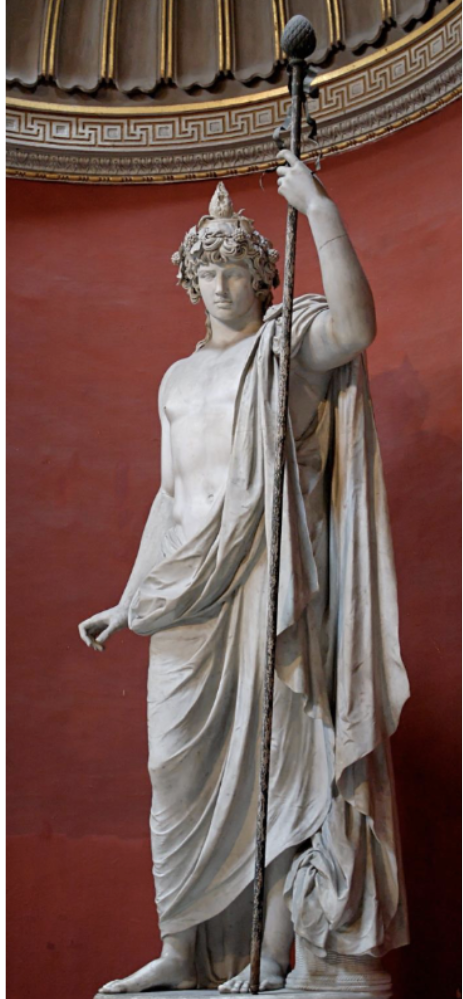
The Final piece depicts Antinous as Dionysus. It was discovered in Hadrian’s Villa in Palestrina, Italy, between 1792 and 1793 in excavations by Hamilton and Robert Fagen. The piece was purchased by Pius VI and housed at Palazzo Braschi; it was later inherited by his nephew, Count Braschi. In 1844, it was sold by the Braschi family for 60,000 francs to Gregory XVI for the Lateran Museum, which was later enveloped into the Vatican Museum, where the piece is currently on display.
The piece serves as my keystone and conclusion to the exhibit. It depicts not only the desirable male body and divine representation in Imperial art, but also the queer longing and desire. The worship of Antinous as a deified being not only by the Romans but also by more contemporary audiences as the “Gay God” plays a role in its position, and as a reason I chose this topic.
Conclusion:
Antinous, as Dionysus, is the final visual representation of this Roman Imperial visual language of queer desire and aesthetic male beauty. Augustus portraiture style combined symbolized divine authority with idealized, youthful male imagery, making this a visual language across the Roman Empire. The figures of Ganymede and Hyacinthus mythologized divine queer longing and showed its prevalence in Roman culture. Objects like the Warren Cup made male same-sex desire materially explicit. Antinous unites all of these traditions into a single monumental figure. As Dionysus, god of ecstasy, transformation, and sensuality, Antinous becomes more than Hadrian’s beloved companion. He becomes the immortalized embodiment of queer beauty, grief, and desire itself. His idealized body, endlessly reproduced through sculpture, transforms personal longing into sacred imagery, preserving homoerotic desire within the visual language of empire. Roman imperial art, therefore, did not merely depict beautiful male bodies but repeatedly aestheticized, monumentalized, and immortalized queer desire through divine and imperial forms.
Works Cited
BURNS, BRYAN E. “Sculpting Antinous: Creations of the Ideal Companion.” Ancient Sex: New Essays, edited by RUBY BLONDELL and KIRK ORMAND, Ohio State University Press, 2015, pp. 285-307. JSTOR, http://www.jstor.com/stable/j.ctv3s8shv.12.
Clarke, John R. “Representations of Male-to-Male Lovemaking.” Looking at Lovemaking, University of California Press, 2001, 64-67 & 82-90.
Clarke, John R. “The Warren Cup and the Contexts for Representations of Male-to-Male Lovemaking in Augustan and Early Julio-Claudian Art.” The Art Bulletin, vol. Vol. 7, no. Number 2, 1993, pp. 275-294. JSTOR, https://www.jstor.org/stable/3045949.
Fagles, Robert, translator. The Iliad of Homer. New York: Penguin Books, 1990.
Hakanen, Ville. “Normative Masculinity and the Decoration of the Tepidarium of the Forum Baths in Pompeii.” American Journal of Archaeology, vol. Volume 124, no. Number 1, 2020, pp. 37–71. https://www.journals.uchicago.edu/doi/epdf/10.3764/aja.124.1.0037.
Hubbard, Thomas K. “Augustan Rome.” Homosexuality in Greece and Rome: A Sourcebook of Basic Documents, University of California Press, 2003, pp. 344 – 382. JSTOR, https://www.jstor.org/stable/10.1525/j.ctt1pp7g1.14.
Kogan Penha, Elisa. “A Mascot For What You’ve Become: Antinous and the Iconography of Queer Grief.” Plebeian: Journal of the Classics Students’ Union at the University of Toronto, vol. VOLUME 10, no. 1, 2024, pp. 71-78. Google Scholar.
Woods, Gregory. “THE MALE BODY.” Articulate Flesh: Male Homo-Eroticism and Modern Poetry, Yale University Press, 1987, pp. 9-50. JSTOR, https://www.jstor.org/stable/j.ctt1dr37w3.5.
Zanker, Paul. “The Great Turning Point: Imitations of a New Imperial Style.” The power of images in the Age of Augustus, Ann Arbor: University of Michigan Press, 1988, pp. 98-100.
Zanker, Paul. “The Mythical Foundations of New Rome.” The power of images in the Age of Augustus, Ann Arbor: University of Michigan Press, 1988, pp. 230-238.